Tufted Titmouse
The Tufted Titmouse is a small flighted bird that can be found in the eastern parts of North America during both summer and winter.
Since these birds do not migrate, they can be found primarily in coniferous forests. They prefer to live near swamps and moving bodies of water such as rivers, creeks, and streams.
The Tufted Titmouse is the largest titmouse in its family, measuring around 6 inches long. The wingspan is 8-10 inches in length and they weigh a mere 18-26 g (0.64-0.92 ounces)! They are a light grey in color with a whitewash belly and rusty flanks. Their distinguishing feature is a small grey crest of feathers on their head.
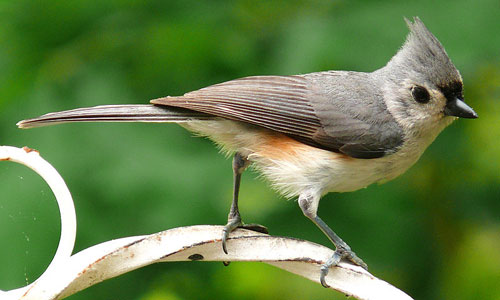
Tufted Titmouse
Their color allows them to blend in with the trees. When the trees are bare in winter and have nothing but their own grey bark for show, that’s when the titmouse will virtually disappear. The males and females look exactly alike, right down to their tiny black eyes.
The camouflage keeps it safe while the titmouse has a deceptive call that one might consider to be ventriloquism. When the titmouse is tucked safely into a nook in a tree, it can begin chirping and actually “throw” its voice into the distance!
The sound might make them seem as if they’re flying away quickly as they stay hidden from sight. A bird of prey that might be after the titmouse would become quite confused and fly off to hunt down the “phantom voice” of the clever bird.
When eating, the titmouse defiantly gets down to business because it chases all of the other birds, which are its size or smaller, away! The bird eats seeds and insects and has no problem hanging upside down to reach some small insect trying to hide in the bark of a tree.
Another interesting ability that the titmouse can do is that it can hold a seed with its foot while eating. When it’s finished eating a single seed it is not uncommon for the titmouse to fly as far as 130 feet to discard the empty shell.
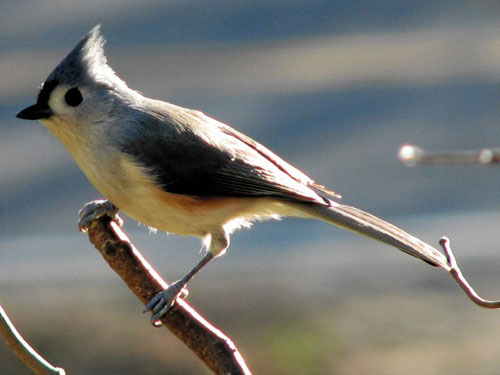
Tufted Titmouse
During the fall and winter, they store food for later use, normally taking only one seed per trip. Typically, they shell the seeds before caching them under slabs of loose bark or in furrows of rough bark.
The Titmouse is paired year-round. They nest in cavities, old woodpecker holes or nest boxes. The female takes about four days to build a nest lining it with hair, cotton, and even shed snake skin. When finished building the nest, she lays from 3-9 (5-6 most common) white, speckled eggs about the size of a dime.
The male feeds her during the 12 to 14 day incubation period when she rarely leaves the nest. Eggs hatch within 24 hours of each other. The eggshells are removed from the nest after hatching. Since the last egg is incubated one day less than the rest, it often does not hatch, or may hatch into a runt.
The hatchlings are almost entirely naked and pink with closed eyes. By the fourth day the eyes are halfway open and on the eighth day, the eyes are fully open. All the down is replaced by day 8–10 and usually by the tenth day, the body is well feathered.
After 14 days the baby birds are covered in feathers and look like the adults. When the birds are 16-18 days old, they fledge. The birds often stay with their parents through the winter and strike out on their own later in the second year. Some yearling titmice usually stay on and assist their parents in raising a brood the following year.
Find out more about the Tufted Titmouse over at Wikipedia »

About Author

Good info about the Tit mouse
they gave really good info bout the tufted titmouse. it rox. im doin a school report and they gave me all the info i needed
Thank you for the compliment. These are such wonderful little birds.