Rainbow Lorikeet
The Rainbow Lorikeet is a very brightly colored bird that lives in the forests and woodland areas of Northern and Eastern Australia.
They have short curved beaks, and small feet with two toes that aim frontward, while another two, on the back of the foot aim backward.
The Rainbow Lorikeet is known for its screeching cries to others of its species.
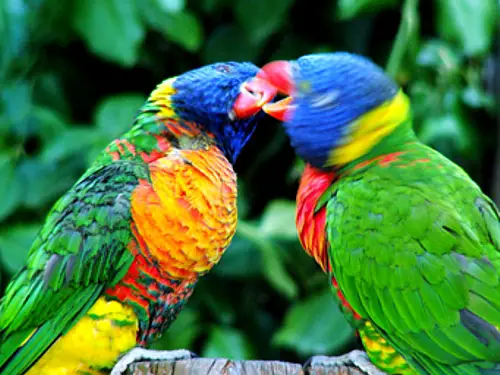
The Rainbow Lorikeet eats primarily pollen
The Rainbow Lorkieet eats nectar and pollen from the blossoms of Australian plants and will fly low over the trees like a miniature bomber, searching for the food it requires.
They will also take in some types of fruit and insects, normally feeding for the most part in the early morning and late afternoon.
The Lorikeet has a very sharp point on the end of its curvy beak that they will use to rip at the fruits of flowers, to get at the pollen or juice, which they then lick up using a tongue that looks very much like a small paintbrush, and lifts the nectar to their mouths.
When breeding season arrives, the Lorikeet will make a nest from sawdust and nest inside a hollow tree.
The Lorikeet will nearly always make their nests near water.
The Female Lorikeet will lay two or three small eggs that are white and very nearly perfectly round, and will incubate them until they hatch, which takes about twenty five days time.
When the eggs hatch the chicks are completely naked, born without any feathers.
Both male and female Lorikeets will feed the chicks and the hatchlings are completely dependent on the parent birds for as long as 6 weeks.
In 8 weeks, the chicks will become feathered, and will be ready to fly.
Usually between 8 and 10 weeks the chicks are ready to fly and leave the nest.

About Author

i have had my rainbow lori for 4-5 years, thinking it was a male – until last night an egg was laid!!! This morning another one ! What does all this mean? and what should i do…
Obviously definitely a female. You need to make sure she has plenty of calcium, a cuddle bone is no where near enough calcium. If she doesn’t have enough calcium she could become what’s called egg bound where she can’t pass an egg. If this happens there is a high probability she could die.
It means your bird is most definitely a female. Unfortunately without amale partner, she can still lay eggs but they won’t be fertile.
I don’t know that your best bet might not be to just remove them, although the female isn’t going to be thrilled with having them taken away.
I would suggest playing it safe, let the egg stay there, or replace it with something else. It’s not fertile, it won’t hatch. No harm done.
That might not be a bad idea. the egg can’t be fertile as there was nothing to fertilize it however the mom wil be less traumatized if you leave it for a day or so.
This just happened to my aunt and her vet told her that this is no good for her bird. Because if the bird continues to lay eggs it will depleate her calcium. What you need to do is move her cage, and the toys to different spots in her cage. This will make her feel unsafe and she will stop laying eggs. Also, you need to leave the eggs in her cage for 25 days. If you remove them before that, she will be tramatized. After 25 days, she will understand that they were “duds” and it will not cause her any trauma to take them away.
We have taken in a fallen bird some 4 – 6 weeks old.
The bird seems to have bonded with us very well over the last 4 weeks.
What are the risks of a healthy bird wanting to fly off at the earliest opportunity ??
So far we can let the bird into trees up to a couple of hundred yards away and he/she will return to us when called. It has been happy to spend up to 3 to 5 hours out there at a time.
What are the chances of survival out there again once seperated from its parents ? – anyone?
Marvalous picture
I had a rainbow lori for like 2 years im 10 and i loved it and 1 day i got up and it had laid an egg it was so amazing i loved it!!!!!!!!
I have a breeding pair of lorikeets, Do they ever stop breeding,and do they breed every year? thank you julie.
hi a friend found a lorrie egg when tree lopping i have been keeping it under a lamp constantly for about 5 days and have been feeling it everyday and the temp seems to go from warm to coolish i can see a pale pinky orange thing on the inside but i dont know if anything is going to come out! please help!
Gday, I have two rainbow lorikeets which i thought were boys but ive had the odd egg. the eggs were laid about 12 months apart, one at a time and were abandoned. ( i found them broken at the bottom of the cage). the two birds sleep under each others wings, i was told that this would mean they are a breeding pair. i have introduced a proper nesting box into their cage. Now at around dusk either one or both dissappear into the box. I have left them alone as much as possible but one is starting to pull out feathers and leaves them in the box. Does this mean theyre making a nest out of their feathers? should i provide them with something to make a nest out of? Any info would be greatly appreciated. cheeers!
beautiful picture
we have just bought a pair of rainbow lorikeet, unfortunatly one has literally flown away,can we buy another to replace it or do have to buy a pair?
got a baby,hand reared and he is the best pet i ever had. I called him baby.
Hi, i have 2 rainbow lorikeets. they have laid 2 eggs twice and both times they havent hatched. i think that it is because of the female having a bath and getting the eggs wet. its also summer here so the eggs shud be warm enough. can anyone give me some advice as to what i shud do? or is it normal to have some clutches that dont hatch?
does anyone know how to tell if a rainbow lorikeet is male or female?
you have to have a blood test done or wait and see if it lays eggs that is the oly way
Wetting the eggs is normal because there needs to be moist in the air. I forgot is it called humidity? and apparently some male lorikeets get rings around there necks. If you cant afford blood test you can probably put in a nest box and check if it lays eggs or not then remove it after your bird gets tired of the eggs
My aunty’s lorikeet bird just laid an egg. We thought it was a male until now. She freaked and called me to check if it is possible to lay an egg without having a male partner. So I searched and found this website. But I am not sure it will lay an egg again or if the egg is fertile.
my lorikeet put himself {so i thought} to bed last nite and woke up to find a egg in the draw it has its own big cage but likes to sleep in the draw beside me looked up this website to see if this was possible, now i know thanks to yous all that it is
I have a rainbow lorie and her name is B.B. What a great bird me and my husband love her to death. As you rainbow lorie owners know these birds are very comical, very active, and very disruptive you have to keep an eye on these liitle birds.
I can’t help but notice here lately my little rootbeer crazed,in my business B.B. has been swooping down at me like its a game. There are times that she has actually been able to grab my hair or touch my head and made me duck my head; with each time she does this she either laugh or do her normal sreech. On top of this my husband does not want to clip her wings anymore; because she flies to wherever we are in the house and she will land on shoulders on command. It has its moments though. I don’t understand why she swoops down on me though; its getting old. Can you HELP!
im doing an assignment and i need to know why rainbow lorikeet chicks are born naked?
PLEASE HELP
hey all i went out to check and change my water and food in the avarie tonight and found an extra bird its dirty and has no feathers under its wings and no tail feathers how do i tell if it a baby of a fly in
a baby lorikeet flew out of its hallow bit of the tree and landed in the back it looked like it was a few weeks old and could kinda fly i just want to know how long it can stay by itself without it being in the nest and we could find it hoping it will be alive tomorro to bring it back so could it still be alive its been out there for a few hours now help me please