Red Panda
The Red Panda is often mistaken for a cat or even a fox because it is quite small being that it is just a little bit larger than your average house cat. The species is classified as endangered with an estimated population of just 2,500 left. The reason for the declining population has to do mostly with habitat fragmentation. In some areas the Red Panda is known as the Lesser Panda or the Shining Cat. The species is the mascot of the Darjeeling international festivals and is the state animal of Sikkim, an Indian state.
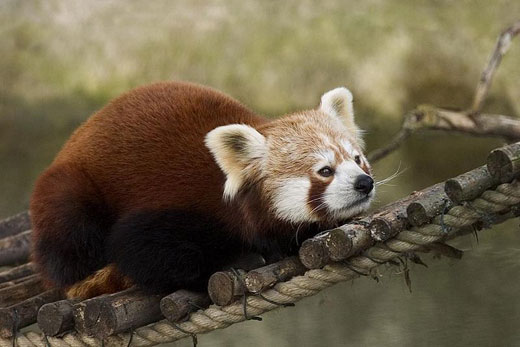
Red Panda
Habitat
The Red Panda is native to southeastern Asia and can be found along the foothills of the Himalayas from western Nepal, Southern Tibet, Bhutan, and Northeast India. The species can also be found in the highlands of Burma, the Yunnan province of China, and the Sichuan province of China as well. The reason that the species is found in these areas is because they lime moderate temperatures with little annual fluctuation.
The Red Panda prefers forested mountains at elevations of 1,800 to 4,800 meters where deciduous and coniferous trees can be found in addition to rhododendron and bamboo. Where you find the Red Panda you will usually find the Giant Panda, as well as these two species are able to coexist. The Red Panda will nest in rock dens and even in hollow trees.
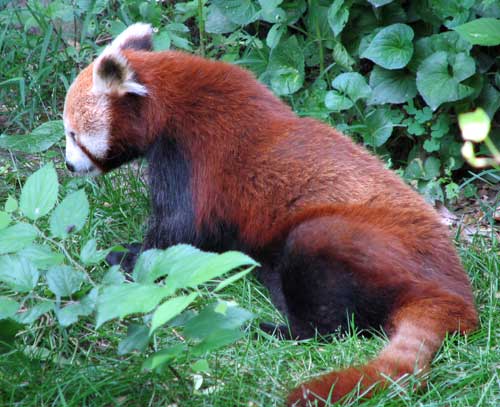
Red Panda
Diet
The Red Panda is known to be most active at dawn and dusk, so during the day you will not typically see them feeding, instead they will be sprawled out over a high branch of a tree resting. The favorite food of the Red Panda is bamboo and that is due in large part to the fact that they cannot digest cellulose so they have to eat a lot of bamboo to survive. The species will also eat berries, a variety of fruit, mushrooms, acorns, grass, lichens, small birds, eggs, rodents, and insects. The animals have a very low calorie diet, which is why they are not all that active. In captivity the Red Panda is also known to eat red meat, which is not seen in the wild.
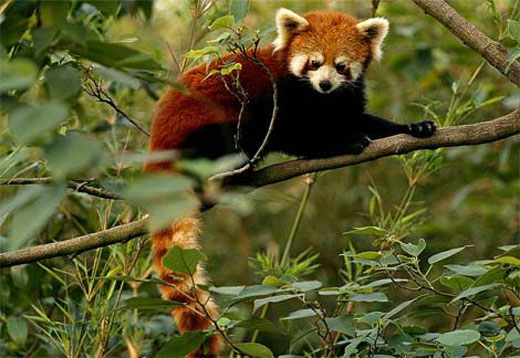
Red Panda
Reproduction
Being that the Red Panda is a solitary animal you will not usually find them together unless it is time to mate, which generally takes place any time from the end of December to the middle of February. The species has a gestation period of 112 to 158 days and the female will then give birth to anywhere from one to four live cubs. The cubs are blind at birth and will not start to open their eyes for about 18 days and they will be fully open by the time they are 40 days old. The mother will care for the cubs in the nest for 12 weeks, but they will not be weaned until they are six to eight months old and will not leave their mother until the birth of the new litter of cubs the next summer. The average life span of the Red Panda is eight to ten years but they are known to live as long as 15 years.
About Author

I think red pandas are so cute! I am doing a report on them! I will not cut down trees in china. Do you have more info on red pandas? If you do, you can email me at aleesh@optonline.net. I look foward to your response! I might be a little young to be submiting this, but I have such a instrest in red pandas! I am only 9, so I don’t have an email address. Bye!
i think its really very sweet of you to be even writing this. ur age doesn’t matter its ur mind and wat goes into it that does so i think its great that u r writing a report on the extinction of red pandas at such a tender age. i am 18 n i hav to make a project on them that’s y i am searchng 4 dem….but 4 u hats off :)
these red pandas are so cute!! i wish i could have one
these pandas are really cuuuuute. i m really impressed with this site. just 1 more thing. can u tell me something about werewolves????? thank u 4 all this matter that is provided
i love red pandas but we have to make them safe!!!!!!!!!!!!!!!!!
the info is nice but doesn’t answer the question specified
there are very cute like a teddy bear
i like redpandas secure their life pls
these poor animals better be on a reserve of some kind they are so cute and i can see why they could easily be mistaken for house pets such as cats but they should not be in captivity they should be on a reserve
I am doing work about habitats and i am doing the red panda it is really good info thank you the person who made all the info up
Top marks for me !! yayyyyyyyyyyyyyyy
bye x
that is so sad! only 2,500 left? looking at the pics reminds me of the song listen to the rain by evanescence! sad song and sad pics! i agree with cookie, we have to do something! ;-;
what does a red panda do for nature i need this by today the 24!
love red pandas they are cute.i am nine send me more informaion
the cutest animal in the world i love red pandas
hello fellow panda enthusiast i love red pandas to they r so cute love u XXXXXXXXXXXXX bye sexy kiss kiss
i agree , they are the besst, love them kallan!
there sooooooooooooo cute i love them OOOOOOOOOOOMMMMMMMMMMMMMMGGGGGGGGGGGG, u lot r so sad!!!!!!!!!!!!! :)
OMG I LOVE RED PANDAS THEY ARE SO CUTE!!!!!!!!!!!! I JUST WANNA SIT ON THE SOFA AND CUDDLE UP TO THE CUTIES, CAN I ADOPT ONE, PLEASE ILL GIVE YOU MY DIGIMON AND POKEMON CARDS. PLEASE I JUST WANNA HAVE ONE FOREVER, love youguyss xxxxxxxxxxxxxxxxxxxxxxxxxxxxxxxxxxxxxxxxxxxxxxxxxxxxxx kissy kissy
hey whats up with pandas
Red pandas are very cute, but unfortunately they are becoming extinct. i love them veeeeeeeeeeeeeeeeeeeeeeeeeeeeeerrrrrrrrrrrrryyyyyyyyyy much
PANDASSSSSSSSS ROCK!!!!!!!!!!!!!!!!!!!!!! :)
aye thees red pandas are sick. . . supah cuties i jus wanna let yall kno that. . . :D
I love Pandas
Pandas’ are my favorite!
I Love red panda i am doing this as a proste in the school hahah(:
They are cute!