Stoat
The stoat is about 12 inches long and is light brown with black tips on their tails. They are quite widely distributed, all over the United Kingdom and Much of Northern Europe. Stoats do not populate North America.
They are carnivores, existing on small rabbits, eggs, birds, voles, mice, chickens and essentially, anything they can get their paws on. Being somewhat less than discriminatory in their eating habits.
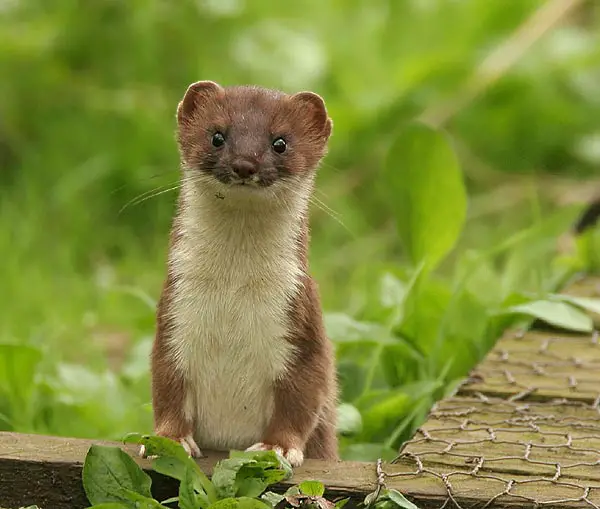
A Stoat, one of the more prolific animals in the UK
Stoats have one litter of infants per year, usually in the spring time, but the breeding actually takes place in the early summer of the previous year.
The stoat female is able to keep the fertilized egg implanted but not active until they permit it to gestate almost a year later.
They will then after 30 days gestation, produce a litter of between six and twelve babies, which are called kits.
The kits are nursed by their parents til they are about two months old and are able to fend for themselves when they are about five weeks old. Interestingly, Kits are very adapt hunters when they reach 4-6 weeks of age.
Stoats do not hibernate during the winter time, instead they prefer stay inside on the colder days. They often turn completely white in the winter time.
A stoat will be mature and ready to mate at about one year and in the wild can live to be up to about ten years old, while a weasel, the cousin which the stoat is often confused with, will live only about three years.
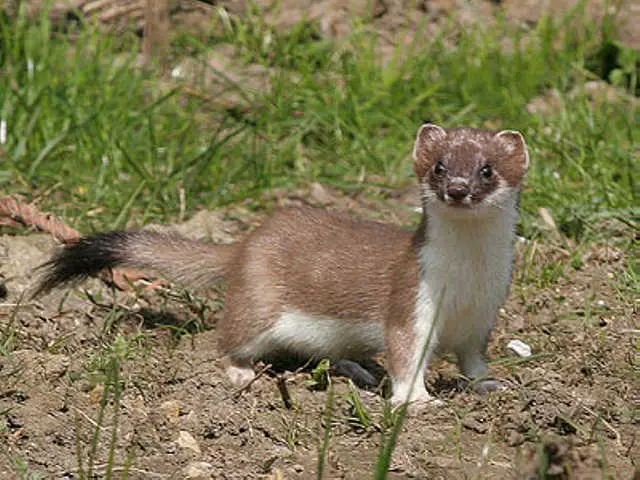
a Stoat in Cheshire
The stoat is in no real danger of extinction in the UK, they are however threatened by hunting, habitat loss, poisoning and often get run over on the country roads.
They do tend to live around farms as the hedgerow habitat and plentiful food supply suits them.
They are particularly good at stealing eggs, such as chicken and game bird eggs, which causes them no small amount of conflict with the farmers.
About Author

Actually, there are indeed stoats in North America. I’ve seen several taxidermied stoats at the Royal Ontario Museum in Toronto. The tags report that the creatures were captured and killed in various locations in rural, northern Ontario.
However, the name “stoat” tends to used much less than in Britain, and “ermine” can refer to the creature all year around, alternating with “weasel”. It’s a shame – “stoat” is a wonderful word for such a bold creature as Mustela erminea…
this is a nice website!
the stoat is so cute but are you sure that is not an danger animal
We have a blue tit sleeping in our camera nest box every night. Today we saw a stoat in the garden fairly adjacent to the box. Is there any danger to the little bird?
ONE EARLY MORNING , LAST SUMMER ,I SAW A STOAT IN MY GARDEN I CONFIRMED THAT ON GOOGLE PICTURES. TWO DAYS AGO I SAW A BABY STOAT (A KIT) . WE LIVE ON THE VERGE OF GREEN BELT AND A FARM ON THE BORDER OF ROYTON AND ROCHDALE IN LANCASHIRE IN THE UK.
It might give you a bit of a bite but will not kill you. It will usually run from you. We have them in the garden and just love watching them. B
my next door neighbour informed me that the other day he saw a stoat eating a frog on his front lawn. It daes confirm that there is a family of stoat in our vicinity.
I’m afraid your blue tit is indeed at risk of becoming a meal, but there is nothing you can – or should – really do about it. If the bird is vigilant and lucky enough, it will escape unharmed. If the stoat is vigilant and lucky enough, it will have a meal.
It’s how Nature works. Think about it this way: chickens aren’t exactly the ugliest of creatures, nor are rabbits, and yet they are eaten by humans. If one thinks like a carnivore, when it comes down to it, nutritional value is more important than beauty. (Of course, that’s not to say that the blue tit isn’t beautiful and a wonderful sight!)
I RESIDE ON THE VERGE OF FARMLAND .WE USED TOM SEE BROWN HARES EVERYDAY EATING GRASS OR JUST SUNBATHING. SINCE LAST YEAR THE FARMER HAS ALLOWED A PERSON TO ROAM THE LAND WITH 2 DOBERMAN DOGS RUNNING FREELY .SINCE THEN THE BROWN HARES HAVE DISSAPPEARED.I WONDER WHETHER THIS ACTION IS WITHIN THE LAW .
of course its withing the law… surely if you live out in the country your fsmiliar with natures ways?? ive lived in the countryside all my life and regularly shoot rabbits and hares. I have also shot stoats as they are not endangered and are considered a pest by many. dude… man up!
TODAY ANOTHER SIGHTING OF A BABY STOAT THIS TIME THE KIT WAS FULLY FLEDGED AND I ASK MY WIFE TO WITNESS THE SIGHTING SINCE SHE HAS NEVER SEEN A STOAT IN OUR OWN GARDEN.
We have a stoat living in our attic. I have seen it, and all too often hear it! Whilst very cute it is a pain at 3am when it seems to want to practice for the international stoat running race. I am told that they are very difficult to catch. Any ideas on how to get it out of the attic most welcome!
WELL WE SUSPECTED THEY WERE IN THE ATTIC CAUSE OF SIMILAR NOSCE AT PECULIAR TIME .IT HAS STOPPED AND THEY HAVE MOVED IN MY GREEN HOUSE I SUSPECT CAUSE THAT WHERE THEY ALWAYS DISSAPEAR.
I USED TO JUMP UP N DOWN N MAKE A LOT OF NOISE IN THE VICINITY BEFORE I GO TO BED N USUALLY IT DOES THE TRICK.
i spotted a stoat trying to get my chicks, luckily i saw it and managed to lock my chicks up, but we think it may have taken my my very large buff orpington cockeral! do you think it would have taken it when 3 hens were left behind, who were much easier pickings, i cant find any evidence of a fight or feathers anywhere, my son is ever so upset as he was the only one we named ben10!
It’s quite possible that the stoat ate your cockerel. A stoat tends to go after a moving target, so if the hens weren’t moving or the cockerel was closer, it would have naturally gone for the “very large buff orpington.”
However, keep in mind that stoats are not the only predators of fowl. Foxes, martens, Polecats, and occasionally even otters have a liking for them, too.
I was interested to see that AVM in February had a stoat in residence in their attic. We also have a family of stoats in our attic and would be interested to hear if they have now departed, and what sort of mess have you experienced.
Wow, this is a sad source of information. They do indeed live in North America and also perhaps you should have mentioned that they are also known as the Ermine, Short-tailed Weasel, or Mustela erminea.
i have noticed in he bottom of our tree in the hedgerow in our back garden, we have a couple of stoats or weasels as i have not noticed the black tip to their tails yet. i have known they have been there since the winter, but never seen them in the open space lol. till today. i think they are youngsters as they are only about 15cm. my query is im going to dig a fish pond in the back garden. is there anyway to discourage the mammals from taking my fish, ie will netting or building it up help. plus what is their appetite like how many visits would they take to the pond to fill them up lol.
Stoats are so adorable! I have been to the UK but never have i seen one.
i live on a estate and i have one in my garden my cat keeps chasing it wil it stay there or disapear.
Redade: An outdoor fish pond is just asking for trouble. I suggest lining the bottom with thick layers of rocks, at least a foot deep, or with concrete. As for protecting them on all other sides, the only thing I can think of is a very, very fine mesh, with the spaces in it no larger than a dime. Stoats and weasels have a way of crawling through small spaces. Certainly have a “door” in it to feed them, but make sure it can be securely closed. In addition, I’d advise you to put the base of the mesh below the stones at the bottom, as stoats can dig. Finally, it’s a good idea to prop this mesh up with large sticks or poles going up from the pond, so the mesh doesn’t sink into the water and trap the fish.
Alena: They’re in parts of North America too, and across much of Northern Eurasia.
Vicky: It’s hard to say. It’s quite possible it will find a different home, but that depends how often the cat goes after it, and the stoat’s own “comfort level” in regards to feline harassment. After all, every stoat has its own unique behaviour patterns and “personality”.
Stoats are EVIL!!!
Why?
Such darling little creatures they are!
There are indeed Stoates in North America. We live in Oregon and found one dead near our barn. We suspect one of our cats killed it. I was concerned that it may be an endangered animal since I have never heard of them before or seen one before.