Tasmanian Tiger
Thylacine is the real name for Tasmanian tiger. It was the largest known carnivorous marsupial of modern times. It is believed to have become extinct in the 20th century. Its dwelling is in Australia and New Guinea. Thylacine is the actual for the tiger, though; Tasmanian is the name which is more commonly used. Although a good number of species related to this tiger have been found in the fossil record dating back to the early Miocene, it was the last extant member of its genus.
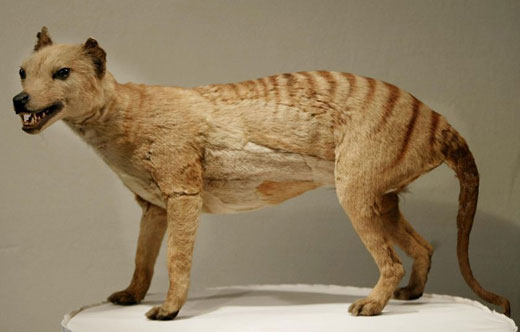
The Tasmanian Tiger
Discovery
It is always interesting to know the discovery of a certain animal. So, this species was first encountered by the indigenous people of Australia. Dating back to at least 1000 BCE, thylacin engravings and rock art have been located and found. At the damper rock Art Precinct on the Burrup Peninsula in Western Australia, petrogylph images of the species can be located. This tiger was rare in Tasmania by the time the first explorers arrived. At the time of arrival of Abel Tasman, Europeans came across this species as early as 1642.
His shore party reportedly saw the footprints of wild beasts’ which were having claws akin to a tiger. In 1772, Marc-Joseph Marion du Fresne reported that he viewed a tiger cat. On 13 May 1792, Frenchmen explored this species and it was the first definitive encounter. This is according to the notifications of the naturalist Kacques Labillardiere in his journal from the expedition carried by D Entrecasteasux. But, in 1805, William Peterson who was the Lieutenant Governor of Tasmania sent an elucidated description for publication in the Sydney Gazete and New South Wales Advertiser.
Description
The description is only restricted to preserved joey specimens; fossil records; skins and skeletal remains; black and white photographs and film of the tiger in captivity. Its body structure was akin to that of a kangaroo with its large, short haired structure and a stiff tail that smoothly stretched from the body similar to that of a kangaroo.
Due to its unusual style and demeanor, some Europeans compared it directly with the Hyena. Its yellow-brown coat is equipped with 13 to 21 distinctive dark stripes across its back, rump and base of its tail. This made way to a nickname “Tiger” The stripes were more visible when the tiger was younger but gradually began to fade as it got older.
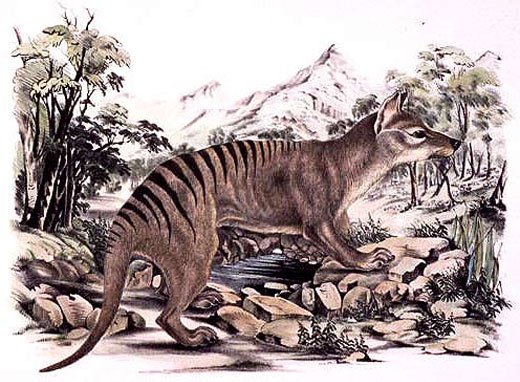
The Tasmanian Tiger
One of the stripes stretched down the outside of the rear thigh. The body hair was dense and soft. It was up to 15mm which comes to about 0.6 inches in length. While it was young, the tip of the tail had a crust. The ears were rounded. They were of 8 cm long and covered with short fur. From light fawn to dark brown; its color varies. As far as the belly is concerned, it was of cream color. Early scientific studies stated that it had an acute sense of smell similar to a dog which caused a prey to be tracked. But, then analysis of its brain structure disclosed that its olfactory bulbs were under developed. Also, it had an unusual style of gait which made it unable to run at high speed, unlike other tigers.

About Author

i love this animal! And the tasmanian tiger its not a fake¨!
Today, 20 May 2008, in a world first, scientists announced that they have extracted a gene from the extinct Tasmanian tiger and successfully inserted it into a mouse embryo. It is the first time a gene from any extinct animal has been brought back to life inside another living creature. Obtaining the thylacine gene, called Col2a1, was itself a major challenge, because DNA begins breaking down after death. However, the researchers from the University of Melbourne and the University of Texas, say the technology will not lead to the cloning of an entire Tasmanian tiger.-Richard Macey, “Extinct gene brought back to life,” in the age.com.au, May 20, 2008.
After reading the above passage in The Melbourne Age, online, I wrote the following personal, historical, philosophical and religious prose-poem on the thylacine.-Ron Price, George Town Tasmania
__________________________
A PERILOUS EXISTENCE
On 7 September 1936 the world’s last captive thylacine or Tasmanian tiger died in the Hobart Zoo. The thylacine is the only mammal to have become extinct in Tasmania since European settlement. I have spent a significant part of my life in northern Tasmanian, where many sightings of the tiger have occurred since 1936.
When the last Tasmanian tiger died in 1936 my maternal grandfather was about to retire on a Canadian old age pension. His wife would die in three years and my mother was about to meet my father. The Baha’i community, which members of my family have been associated with in Canada now for fifty-five years, was, in September 1936, just beginning to conceive a plan to establish one centre in every state of the USA and in every country in Central and South America with ramifications to include every country on the European continent.(1) By the end of that plan, a seven year plan from 1937 to 1944, my parents had met and married. On 23 July 1944 I was born, three days after an assassination attempt on the life of Hitler and four days before another planned assassination on his life. -Ron Price with thanks to (1) Shoghi Effendi, Messages To America, Wilmette, 1947, p.7.
Indeed, the field was immense,
the task gigantic, the privilege
immeasurably precious, but the
time was short, obligations sacred,
paramount and urgent to muster
all our force, our resources, our
faith, determination and energy
to set out, single-minded and
undaunted, to attain exertion’s
heights—as humanity entered
the outer fringes of the most
perilous stage of its existence
and as the thylacine was in the
last phase of its existence—or
so it seemed until the other day.
Ron Price
20 May 2008
hehe i agree with nancy the tasmanian tiger is not fake !
im do a research paper on the tasmanian tiger for language and ive always had a thing for this creature because i love animals and if i see one i find interesting then i beging to learn more about the animal i find this animal very intreging and i think that mabey if sciencetist can bring it back then tht will b great
awesome
I think if each and everyone of us does something to prevent extinction the world will be such a greater place for our children and future generations to live in.
Maybe the United states of America and other countries should look into the tankers dumping their sludge in the ocean, yes it is happening, it is cost effecient for the companies instead of paying for it to be pumped from the ships, meanwhile no so effecient for marine life.
i just learned about it at school tusday and decided to look it up i think is a pretty cool animal lol i hope they can bring it back that would be a big breack through and we could learn more about it in fact its awesome
Back in the 1980s when I was teaching letter writing as part of English courses, I thought the letter, as a genre of writing, was on the verge of extinction. Had it not been for the email’s resurrecting role the letter may have gone extinct. With the world population tripling in my lifetime(1944-2010) from 2.3 to 6.9 billion people, I’m sure the letter and, of course, now the email, has been in safe hands simply due to the population increase. I’m sure it continues to function and give pleasure to melancholy and joyful==as well as other–moods.
And yet another variety of extinction as described by T.S. Eliot in his poetry.-Ron
GERONTION 2
This poem draws heavily on a poem by T.S. Eliot called Gerontion. It is about a fallen and dreaming humanity, a present age of decrepitude and impotence, a spiritually deceased world on its way to extinction. My poem links Eliot and some aspects of the new forces of this newly emerging religion, the Baha’i Faith, together.-Ron Price, Pioneering Over Four Epochs, 11 October 1998.
Too long a sacrifice
Can make a stone of the heart.
-W.B. Yeats
The reality of sacrifice is that there is no sacrifice.
-‘Abdu’l-Baha
These poems are spun around moments
in centres and circles, the fruit of a life-
time of breathings, seeings and hearings.
Here I am, a man in the evening of his life,
in an Antipodean town near the ocean,
listening to Bach and my printer buzz.
I was not at Tabarsi, nor did my blood
drop anywhere in Persia, then, or now.
My wife helps out in the neighbourhood
and my son finishes his service in Haifa.
I will go for a walk in a few minutes.
I will also give this poem a pithy and
profound coherence in the next lines.
There is no nightmare vision here
or a series of dissconnected parts.
The ressurection has come to pass
and is here in the Kingdom of His signs.(1)
I do not address this poem to the
Gerontians among us for whom those
gems of utterance were not intended(2)
and who would not respond then, or now.
(1) Baha’u’llah, Epistle to the Son of the Wolf, p.131.
(2) T.S. Eliot has a poem called Gerontion which he wrote between May 1917 and May/June 1919. A Gerontion is (i) a little old man(Greek), (ii)a little old dried-up evangelist, (iii) a dull head, (iv) a figure without moral authority, (v) a person who is ‘relaxed and uncommitted’ and wants to keep it that way; and (vi) symbolic of what is empty and dry in our civilization and incapable of responding to ultimate truth and beauty.
-Those ‘gems of utterance’ are the Tablets of the Divine Plan written and first promulgated at the same time the poem Gerontion was written.
————————–
I do beleive its not a fake. But I wonder how this animal with the struckter of a dog has became a feline? AnyWays I love Tiger so AWsOME
coolest animal ever!
this is so wonderful 2 me i hope yall like it got 2 go ttyl