Salps
Many people have never heard of salps until they come across them when they are in one of many oceans around the world. A salp is an unusual looking creature that is a free floating tunicate and is barrel shaped. The creature is able to move by pumping water through its body, which is jelly like. When the salp pumps the water through its body it strains it and feeds on the phytoplankton that is in the water. These tunicates are quite interesting to look at because of the simple yet complex way that they move through the water and feed at the same time.
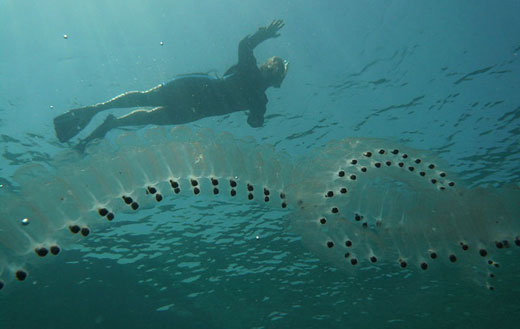
A string of salp captured in the Red Sea
Habitat
Salps are found in most seas but are found in the largest amount in the Southern Ocean. You may see just a few at a time in other areas, but in the Southern Ocean they are usually seen in deep waters and are in large groups or swarms. The animals float on their faces on their own or they are often in colonies that float together in a string or rope like manner. It’s quite impressive when you see a whole colony of salp, moving along together in perfect rhythm.
Diet
Salps dine on phytoplankton and they move around the seas according to phytoplankton blooms. When there are many phytoplankton the salps move into the area and consume them all. The species is so adept and successful when there is plenty of food that they can actually clone themselves and the clones graze upon the phytoplankton and grow faster than any other multi-cellular animals.
What is interesting is that because the salps have to pull the water through their bodies to both eat and move, when they are in very dense populations of phytoplankton they can actually become clogged with their food source and sink! When this happens it is not uncommon for the beaches to be full of slippery salp bodies that have become clogged and then wash up onto the beaches. In areas with dense phytoplankton populations it is common to see the salp bodies on the beaches, especially during phytoplankton blooms. Because the salp feed off the phytoplankton but can become clogged with them, causing their demise, the two species are always in competition with both of their numbers fluctuating in any given area or period of time.
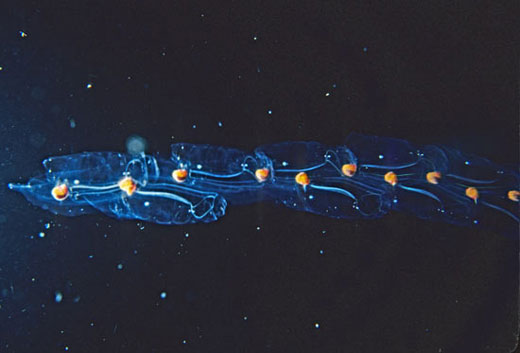
The Salp
Impact on the Ocean
At first glance the salp seems very unimportant or inconsequential to ocean life, but this is not the case. The fact is, both sinking fecal pellets from the species as well as salp bodies bring carbon to the sea floor. It wouldn’t be a big deal if there were just a few salp, but there are enough of both the fecal matter as well as the bodies on the ocean floor that the species has a huge impact on the biological pump of the ocean. Because of this impact, the density of salp in an area is known to change the ocean’s carbon cycle, and even contribute to climate changes in the area!

About Author

salps are awsome
have you seen one in ur real life?
i havent seen in real life but i wish to see it cuz i just heard of it and understood how important they can be in our life on earth.
I WANT A PET SALP
hahahaha looooool, pet salp!?!! i just wonder why you want a salp as a pet? is your house that much polluted that you need salps to clean it up?
joke loool
i love to have one as well in my bedchamber. its the first time i have heard of it and i found out how important they can be to our life on earth!
i really wish that i could see them in real….
I have seen them all to close at the Jersey Shore. When I tried to swim I was covered in them and when you try to walk on the beach you can’t avoid them and you slip on them. It is just like goo. They are very interesting but it is not a lot of fun to swim with them. It is kind of gross.
Salps even contribute to climate changes in an area.
Do they encrease global warming?
no loool, they are not there for to release more carbon dioxide in the air. it says that they are contributes with the climate change, it mean that they help us to reduce the amount of carbon dioxide. the decrease the global warming not increase.
but im not sure my friend that is what i understand from the quote above! if its true then its a credit to us human!
I saw my first salp in the Canary Islands last weekend. What a bizarre looking animal! Loved seeing it and learning about it.
Anyone ever seen “The Abyss?” awesome movie. The alien creature things remind me of salps.
hahaha yh! ive seen that film and i love it, its quite nice film!
if salps can contribute and help us to solve the problems that we facing today because of climate change, what we can do to increase their number to maintain or level the amount of carbon dioxide?
this is the first time i have heard of salps and im very curious about it, i love to know more about it. its like a new way of solving the problems that we are facing today as a world! if its true!!!
The average swarm of Salp remove 4000 tons of carbon each night! Maybe Salps are the way forward!!
i think they cant help if we carry on they way we produce carbon today but there is hope!
Actually, this profusion of salps is not a good thing……reading from The Ptarmigan’s Dilemma page 335 says salps are becoming more abundant due to the decrease of krill, because the preferred food of krill is decreasing and filling the eco spot is the preferred food of salps. Less nutritious & way more prolific; I thought our future food was to be jellyfish (comb jellies) but now maybe farmed salps. Remember less nutritious & is now at the #1 spot on the food chain. Explains a lot of ‘starvation’ doesn’t it. Mother Nature getting into the fall-back position.
By the way, excellent book, PD
I’ve seen many different salps and colonial salps in Santa Monica bay and other places in the ‘Pacific Ocean’ but one petecular one I have only seen rearly is the pyrosoma a very beautiful animal with it’s lavender purple overtones. When ever im out at sea im looking for anything interesting, but have’tn seen pyrosoma in a very long time, but I will keep looking. The times I did see them we only about a mile or so offshore in water maybe 90 feet, at palo verde pensular.
If you want to see salps come to the Jersey Shore. They have been all over the beaches in Ocean County for the past several weeks. They are a nuisance to swimmers and especially fishermen as they stick to your fishing line.
Come and visit the Pescador Island here in Cebu Island, Philippines. Here you can see a long chains of salps…also the sardine run, frogfishes, school of tuna and threshersharks.
They are tiny breast implants for little people.
Do salps carry radioactive Fukushima waste across the ocean?